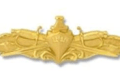
The officers below suffered from a very high, but distorted opinion of themselves as leaders and “surface warfare officers.” I feel sad for them. There is so much more to being a “SWO” than regurgitating technical knowledge, and these officers completely missed the big picture about the leadership failures that occurred on the USS Point Loma. The sexual misconduct and harassment that went entirely undisciplined, culminating in a rape of a crewmember and a court-martial, the corrupt and fake qualifications awarded to ineligible/incompetent officers, non-existent training for bridge watchstanders, the Port Hueneme collision, the loss of port anchor and chain, loss of classified material, loss of ship’s store funds and inventory, favoritism and scapegoating, abuse of authority, cronyism that enabled a former XO to get command of a ship where he was relieved of command after a crewmember’s preventable death at sea, and the highest drug abuse of all vessels in Submarine Pacific. But, the navy thinks there is nothing to see here, so move along. Fortunately, the careers of these officers did not go far. They are now fat, dumb and happy retirees and veterans who have nothing to say, except to hide the truth.
I have gone out of my way to inform the below former officers about this post, asking them to correct any inaccuracies. So far, they have remained silent. I welcome their comments.
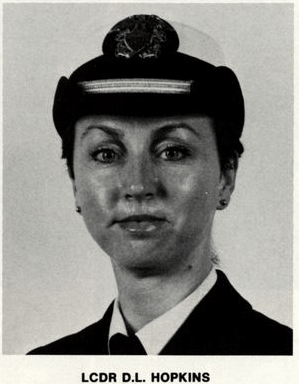
Then LT. Donna Hopkins arrived in 1980, as an 1160 SWO in training, and the USS Point Loma was her initial sea tour. She was assigned as Damage Control Assistant (DCA). Her underway time was minimal, considering that the ship underwent a major overhaul at Mare Island Shipyard between 1980-1982. Then Commanding Officer, R.F. Grant awarded her SWO qualification in 1982, soon after completion of the overhaul. Under the CO, DJ O’Shea, she was re-assigned as Navigator. In March 1983, she became the Senior Watch Officer. Hopkins met with each woman officer separately and attempted to persuade each of us to remain on shore duty after completion of our tour on the Point Loma, because “I do not want the competition.” She used her position to delay and deny SWO qualifications to other junior line officers, which made her assignment a conflict of interest. The strategy was intended to keep her peers off the selection list for SWO Department Head School at least until she was selected. LT Hopkins slandered and sabotaged me and others at every available opportunity, while currying favor with the Commanding Officer, Capt. D.J. O’Shea. By providing negative input to her peers’ performance evaluations, she secured her rank as #1 LT, with the highest grades. Hopkins bitterly resigned her active duty commission sometime after serving on the USS Cape Cod, and joined the Naval Reserve.

In May 1982, Donald J. O’Shea arrived to command the USS Point Loma. He relieved CDR Richard F. Grant. Both were submarine diesel boat officers, who were granted automatic SWO qualifications. Neither officer previously served on a surface ship. Rumor had it that O’Shea’s seniors told him to get married to erase his reputation as a “womanizer”, especially since he would be commanding a ship with women on it. As if getting married was supposed to change his behavior. Enroute from his previous tour, O’Shea quickly managed to find a fiancée, who he married in June 1982, and all of us attended the wedding. The navy is not above making deals like this with prospective COs; to “normalize” them for PR. O’Shea abandoned 5 biological children from his first marriage. They rarely ever saw him, and none attended or even knew about the wedding, according to one of his granddaughters who said she met him only once. Three months after the wedding, he filed for divorce and remained a bachelor for the remainder of his tour. With 29 years of service, O’Shea was a burnout. Despite that, he was promoted to Captain in 1983. He never attended SWO boards and he never asked junior officers SWO related questions. He delegated the process to LT Hopkins, an inexperienced junior officer with an agenda to remove her competition. During O’Shea’s tenure, the ship experienced a collision at Port Hueneme harbor, resulting in about $70k in claims against the government. O’Shea was awarded a Punitive Letter of Admonition for negligent hazarding of a vessel which is a UCMJ violation. Earlier that year, the ship lost its port anchor and all 900 feet of chain, which was blamed on a faulty fathometer reading that caused the chief Boatswain’s Mate to “free-fall” the anchor in water he believed to be only 20 fathoms, but the actual depth was much deeper. The momentum of the fall caused the bitter end of the chain to break off, a potentially deadly situation. The anchor/chain was later replaced for about $125K in 1983 dollars. The ship’s Classified Material Custodian (CMC) lost classified material that was allegedly never recovered. The supply department experienced unaccounted for losses of ship’s store funds and inventory, more than once. A female ensign was blamed, she was removed “for cause”, and the LT Supply Officer was then rewarded with a Navy Achievement Medal in the same period. Sexual misconduct and harassment was frequent with no accountability. The Point Loma had the highest number of random drug test “positives” of any vessel in SUBPAC. High turnover of officers and crew caused unit cohesion to suffer. But hey, in the words of one adoring crewmember on the USS Point Loma’s Facebook page, “What a skipper”! After one additional tour of duty ashore, O’Shea retired in 1987. He died in 2006.

In 1981, LCDR Robert J. Tyler, a submarine officer, was the ship’s Executive Officer (XO), after having served previously as a weapons officer on a SSBN (a nuclear-powered sub). He had no previous assignments on a surface ship, but he was soon granted SWO qualification after arrival. His leadership was chaotic, causing grief over constantly changing priorities, much of it was for “window dressing” the ship. Tyler once cautioned me to not speak openly about a married female crewmember’s pregnancy, even though it was no secret, and she would be transferred to shore duty. He said, “you never know who actually gets these women pregnant.” Tyler asked for assistance from subordinate officers to help him move out of his San Diego home on a weekend. As furniture was being loaded into LT Donald Price’s pickup truck, Mrs. Tyler arrived home in amazement and shock. That was when LCDR Tyler told her the marriage was over. The following year, Tyler was married for the third time. Captain O’Shea recommended LCDR Tyler for command at sea, and promotion to CDR. In 1983, he was selected for CDR and command of the USS Florikan, a diving ship assigned to the same squadron as the Point Loma (under the same Commodore). With no previous experience as a Navy diver, he was sent to Navy Diving School. In December, 1984, a Florikan enlisted diver perished at sea during a routine underway mission. The ensuing investigation resulted in Tyler’s removal as CO, and letters of reprimand for him and at least 3 others. Tyler soon retired from the Navy.

LCDR Joseph W. Keegan, arrived in 1983 to replace LCDR Tyler (above) as Executive Officer. A submarine officer, he previously served as a weapons officer on a SSBN. He had no previous assignment to a surface ship, but he was soon granted SWO qualification after arrival with no known testing prior to award. He never attended SWO boards, except for one occasion when Capt. O’Shea ordered him to attend one for LT. Laurie Cason (below). In 1984, several months after his SWO qualification, Keegan failed a written Rules of the Road exam, according to the ship’s navigator. Keegan was my immediate superior. Less than 3 months prior to my first SWO board, Keegan wrote that my progress towards final qualification as OOD underway was satisfactory, no one disagreed. On the same day I was to appear before a SWO oral board, LCDR Keegan attempted to give me a letter of reprimand that he later withdrew. He wanted to blame me for classified material lost by the CMS Custodian. To my knowledge, he never took the ship’s conn while underway. Avatars will have to do until any photos become available.

LCDR Joseph Hansen was the ship’s Chief Engineer in 1983, and an LDO (Limited Duty Officer). He was a submarine officer, and a married father of 3 children. In 1984, Hansen assumed the collateral duty as Senior Watch Officer, succeeding LT Hopkins. In 1984, I filed a complaint of “quid pro quo” sexual harassment against him, which occurred while the ship was moored at Long Beach Naval Shipyard. In sworn affidavits, I reported that he wanted an affair in exchange for professional help that I sought to prepare for an oral “do or die” board. He related details to me about his marital problems, saying he didn’t want anyone else to know about it. He admitted to encounters with other women I didn’t know. Hansen criticized the other women officers as unattractive and/or incompetent. As it turned out, he was assigned to be one of the members of the oral board I sought help for, held in April 1984 at the Commodore’s staff office. I was not allowed to question the composition of the panel. Hansen voted against me, which I saw as retaliation. Previously, in December 1983, Hansen evaluated me at an oral board to test knowledge for SWO qualification, and his comments then were far more positive. Hansen submitted two unsworn statements in response to my sexual harassment complaints. In his second statement, he changed his story, and investigators never challenged him.
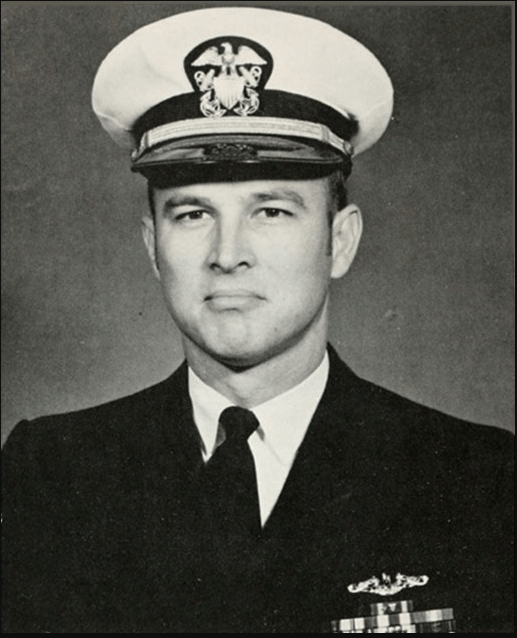
In 1983/84, CDR Robert Killion, a diesel submarine officer, was the Commodore’s Chief of Staff at the squadron office, known as Commander, Submarine Development Group One, located in San Diego. Killion had no known assignment to a surface ship, but somehow, he was awarded SWO qualification despite being ineligible. It was awarded by his boss, the Commodore, another submarine officer. One day, while in CDR Killion’s office, he told me “women are not expected to qualify (SWO), it’s just a decoration.” Then he showed me his SWO pin, which he kept in his desk drawer, not bothering to wear it on his uniform. He ignored the fact that navy policy requires all surface line (1160) officers to obtain this qualification during their initial sea tour, regardless of gender. Killion tried to deceive me into believing that I could continue my naval career ashore. He never offered any facts to support his claims. He chaired an unnecessary, arbitrary “do or die” board to determine whether I should be reassigned to another surface ship after CAPT O’Shea denied SWO qualification to me. The navy refused to investigate my complaints of CDR Killion.

LT Constance “Connie” Harris, arrived as an 1160 SWO in training in 1981. The Point Loma was her initial sea tour. She was assigned first to the Engineering Department as “A” division officer, which was responsible for the ship’s auxiliary topside equipment. Harris did not appreciate professional criticism from anyone and sought retaliation at every occurrence. Her greatest skill was in rallying the lesbian mafia and junior crewmembers to turn against officers that rubbed her the wrong way. Once, she threatened to “beat my ass” in front of enlisted men, and after I reported it, the CO ordered her to apologize. In June/July 1983, she was ordered to relieve me as Operations Officer as part of a normal assignment rotation. Harris suddenly came down with a mysterious, undisclosed illness that resulted in her being absent on sick leave for at least 45 days, missing the first Trident Missile test launch in July, 1983. During that absence, she called the XO from a Las Vegas casino, updating him on her recovery. No one noticed the problem. After returning, she remained hostile to me throughout the department head relieving process, making communication difficult. Despite a long absence, she was miraculously granted SWO qualification after one board, and relieved me as Operations Officer, with about 8 months remaining in her tour of duty. Not much time to get acclimated to a position of greater responsibility for which she lacked experience and training. Her active-duty service ended just short of 18 years (including about 2 years enlisted time). That is only two years before retirement eligibility. She was likely passed over for Commander and had to leave because of the Navy’s “up or out” promotion system.

LT. Laurie Cason arrived as an 1160 SWO in training in early 1982. She failed to qualify SWO during her previous shipboard assignment (USS Orion (AS-18)), a submarine tender. The alleged reason was that the ship failed to afford enough underway time to qualify as OOD underway. Cason admitted that another female officer on that ship was awarded SWO qualification, but reasons were unclear. She referred to the USS Orion as “the ship that hated women”, because of repeated insulting comments by seniors. She and LT Harris (above) became a known couple, at a time when the navy’s policy on gays in the military was that it was “incompatible with military service.” In the 1980s, senior officers were reticent to take action on gays in the military because of bad media publicity, shaming military leaders into avoiding the issue. Harris and Cason both retaliated against any professional criticism, taking it personally. In 1983, Cason appeared before 3 SWO boards before finally being granted qualification. Each of those boards was chaired by LT Hopkins (above). For the 3rd board, Capt. O’Shea ordered the XO, LCDR Keegan, to attend. By this action, Capt O’Shea showed sufficient skepticism of LT Hopkins to chair these SWO boards fairly. For some reason, LT Hopkins later removed the original board member comments of LT Cason, and replaced them with comments in her own handwriting, effectively whitewashing any criticism of Cason’s responses to questions. One has to wonder why this was done, and on whose order. After completing her TOD on the Point Loma, Cason voluntarily changed her designator to 1100, General Unrestricted Line, and continued her career ashore until she retired at the rank of Captain.

LTJG Diane Lane arrived as an Ensign, 1160 SWO in training in 1982. The Point Loma was her initial sea tour. She was assigned to be Communications Officer, as part of the Operations Department. That meant she was my subordinate while I was assigned Operations Officer. LTJG Lane was also assigned as the ship’s Classified Material Custodian (CMC). It was a collateral duty that made her directly accountable to the Commanding Officer. She lost classified material that was allegedly never recovered, and she was signed as having sole custody. In a memo, LT Hopkins described Lane as “utterly floundering” as Communications division officer, attempting to blame me for her failures. Nevertheless, Lane was awarded a SWO qualification despite oral board comments that she “lacked maturity, judgment, assessment of priorities, depth of knowledge requires more effort before qualification.” Nevertheless, a very lenient standard for Officer of the Deck (OOD) and SWO qualification was allowed for her to qualify. In early 1984, LCDR Hansen admitted to me that he had numerous personal discussions with LTJG Lane, encouraging her to leave the Navy. At the end of LTJG Lane’s tour of duty on the Point Loma in 1985, she resigned from the Navy.

LCDR D.R. Switzer, JAG Corps, USN, was assigned to do the sham investigation into my Article 138 Complaint of Wrong. Switzer never interviewed me, believing that my written complaint was enough. All statements he obtained were unsworn, and no one knows what questions he asked of other officers he interviewed. He simply allowed them to say whatever defamatory comments they wanted to make about my job performance, even though they had no knowledge of the sexual harassment incident. He could have asked them about ship’s history of sexual misconduct and harassment, but he didn’t. I was never invited to respond to their comments. Even though LCDR Hansen (above) submitted a statement that contradicted a previous statement, Switzer never challenged him. Switzer did not interview Capt. O’Shea, who saw me approach LCDR Hansen’s BOQ room one night at Long Beach Naval Shipyard. Switzer quickly concluded that my claims could not be substantiated. Must be good enough for government work. He probably got another promotion out of it, by giving the chain of command the outcome they wanted. This so-called investigation was designed as a smear campaign to discredit me. Ironically, this Article 138 complaint was attached as evidence to a rape incident and investigation that occurred several months later. I’ve submitted a PA/FOIA to get a copy of the rape investigation. Why would the navy attach my complaint to a rape investigation if there was no merit to my complaint?

I met then ENS James Coltellaro in 1981, before I actually reported aboard. On the weekend, I was invited to meet him and the XO, LCDR Tyler (above) and some others for a day of water-skiing on Lake Berryessa, a few miles away from Mare Island Naval Shipyard in northern California. Coltellaro admitted that he smoked weed with the troops, fraternized with enlisted crewmembers, and the worst grade he received on a performance evaluation was a C for military bearing. He claimed that then Commanding Officer (Richard F. Grant) was having an affair with the Operations Officer (LT Dorothy Nichols). Coltellaro claimed to have had a sexual encounter with LT. Catherine Leahey, who was his superior officer at the time. After CDR DJ O’Shea became CO in 1982, Coltellaro pursued a relationship with an enlisted crewmember, Seamen Apprentice Naomi O’Brien, assigned to the Supply department. One day, O’Brien went AWOL. After 2 weeks, she decided to call the ship and Ensign Martha Patton (Assistant Supply Officer) took the call. The phone number she called from was traced to Coltellaro’s apartment. Coltellaro was confronted with this fact, and he admitted that O’Brien was staying with him. He knowingly kept an AWOL crewmember, which could have sent him to a court martial. After O’Brien returned to the ship, she received Non-Judicial Punishment (NJP) for the absence. However, there was no discipline for Coltellaro. About a month later, Coltellaro was awarded SWO qualification and a performance evaluation with the highest grades and comments. O’Shea said to him (allegedly), “We don’t f*** the help.” Coltellaro’s career continued as if nothing had happened.
Everyone Says They Hate a Liar. Try Being the One Who Tells the Truth.
In the US Navy, there is no better way to become unpopular than to report the truth when everyone else is lying “for the good of the service”. Evidently, the navy believes that truthtellers need to be punished, and the evidence is substantial that I was retaliated against. I was blacklisted for what I reported, denied promotion and retention despite receiving receiving excellent performance evaluations at my following assignment. The navy’s propaganda about these gender-integrated non-combatant ships is ridiculous by stunning omissions of fact. Someone has to tell the truth about it. The navy had every incentive to smear me and cover up the truth, and that is just what they did.
Fake SWO Qualifications and a Coverup
Fake warfare qualifications have no value to me, other than to expose it for what it is. The SWO qualification was mandatory for all 1160 surface line officers. No one in the USS Point Loma’s chain of command cared about the fraud, waste and abuse, but I do. No one in the chain of command monitored the integrity of the SWO and ESWS qualification program, but I did. Was this dereliction of duty? Negligence? The warfare qualification program on the USS Point Loma was fake and corrupt for the following reasons:
- It was a surface ship assigned to a submarine chain of command that clearly had greater priorities
- It was a non-combatant ship unable to provide real SWO experience of a warship. No installed weapons systems, no steaming in formation with other vessels, no underway replenishment capability, no aircraft landing capability, no tactical maneuvering. Anyone with a SWO qualification from the USS Point Loma and no other surface ship experience would be at a distinct disadvantage anywhere else in the surface navy.
- No minimum knowledge standards were ever promulgated, leading to arbitrary standards which allowed leniency for some officers based on politics, not merit.
- There was no organized bridge watchstander training or mentorship.
- The commanding officer D.J. O’Shea never attended SWO boards, or asked SWO related questions of candidates at any other time. He delegated that task to an inexperienced LT (Hopkins) with an agenda to hurt her competition, whom she was allowed to evaluate. He simply lent his signatures based on tainted opinions.
- Senior submarine officers who were granted SWO qualifications had no known prior experience on a surface ship, none were tested prior to award. For example, LCDR J.W. Keegan, the ship’s XO, was awarded SWO qualification soon after arriving for duty. He was not tested prior to award. Months later, Keegan failed a written Rules of the Road test, according to the ship’s navigator, LT Lewandowski.
My Fair Weather Friends

This is Kathleen Dussault, who was a LT Supply Officer on the USS Point Loma from 1981-1983. Some miracle resulted in her being promoted to Rear Admiral, and she retired in 2009 after about 30 years active duty. She is the only officer who served on the USS Point Loma to reach flag rank. When Kathleen reported aboard in 1981 and needed a place to stay, I had an extra bedroom available at my rented apartment in Vallejo, CA and we shared that apartment until the overhaul at Mare Island shipyard was completed in April 1982. As Supply Department Head, Dussault was maligned by other officers every bit as much as I was as Operations Officer. But, when others attacked her, I defended her. She and I spoke often about the ship’s problems. When her tour of duty completed in late 1983, I helped her with moving to her next duty station in Torrance, CA. Maybe she forgot about all that. When I reported the sexual harassment, she provided an unsworn statement that took irrelevant, unqualified cheap shots at my job performance. Years later, we chatted online a few times. When I made her aware of this website, she refused any further correspondence. She is safely retired, but has nothing to say about her tour of duty on the USS Point Loma, or this website.
This is Donald R. Price, who was a LT, in charge of the Deck Department while on the USS Point Loma, from 1980-1983. Price was former enlisted, with extensive prior experience at sea, and a great shiphandler. He was one of the most admired officers on the ship, and many SWO candidates, including me, wanted him to be our mentor. After completing his tour of duty on the Point Loma, he went to a shore command in the San Diego area. We spoke often about the ship’s problems. After relating to him what DJ O’Shea had done to me, he said “The Navy doesn’t know what they are looking for..(in SWO officers)”. He related stories of other officers he knew who were arbitrarily attacked and destroyed based on nothing. To some extent, I would agree with Price, except that I think the navy knows what they want in SWOs, they don’t dare say it out loud. When you are a navy officer, honesty is not the best policy. Price retired from the navy many years ago as a Captain. He will not respond or make any comments about this website.

This is then LTJG Linda M. Lewandowski. She came to the USS Point Loma in 1983, after being SWO qualified at her previous ship, USS Dixon, a destroyer tender, also homeported in San Diego. She was assigned to relieve LT Donna Hopkins as Navigator. We spoke often about the ship’s problems. She acknowledged in a letter that the Point Loma did not have “organized bridge watchstander training”. She also admitted that LCDR Keegan, XO, failed a Rules of the Road exam in spring of 1984, several months after he was granted SWO qualification. Linda also told me that in spring 1984, LTJG Diane Lane (SWO qualified) failed to respond to a bonafide steering casualty, which caused the ship to move around in circles for several minutes, without the CO’s knowledge. Of course, no one was interested in investigating. Linda retired as a Captain, after a very successful career in the SWO community. Linda refuses to acknowledge this website or provide any comments.
Author
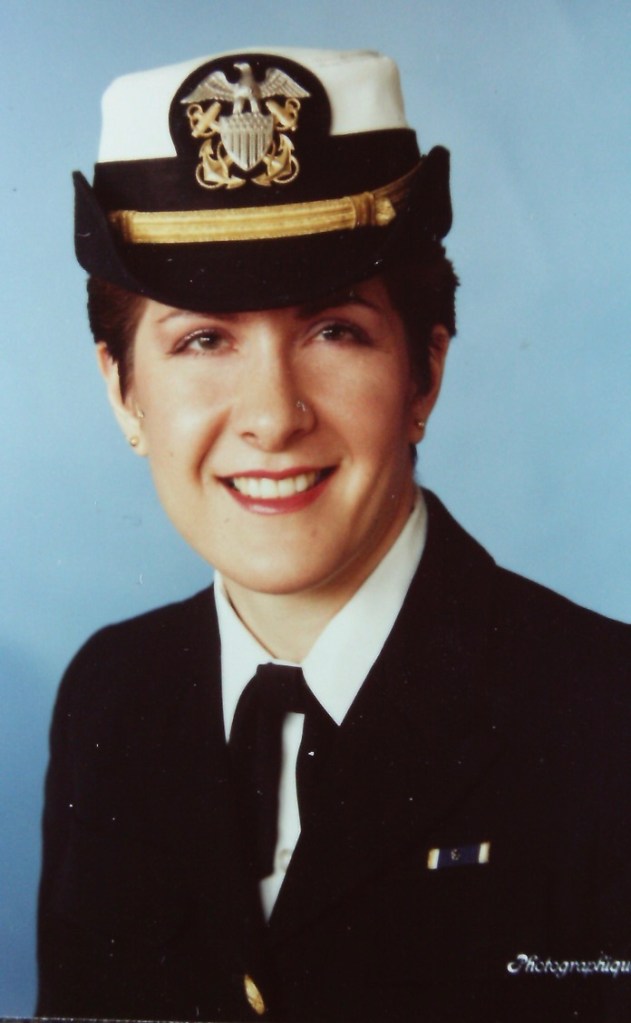
This is LT Melanie Collins, back in the day. When I reported to the USS Point Loma in July, 1981, the ship was in overhaul at Mare Island Naval Shipyard, and in drydock. I was first assigned as “E” (Electrical) Division Officer for a few months, then reassigned as Communications Officer, based on my previous experience as Comm Officer ashore. The overhaul was completed in April 1982, and the ship returned to its San Diego homeport. In June 1982, I relieved LT Catherine Leahey as Operations Officer, after completion of her TOD. With less than 2 months underway time, 1 year as a shipboard division officer, non-SWO qualified, and not eligible for SWO department head school (SWO qualification was required to attend), there I was. That’s like putting someone into a locked closet, with the key on the other side of the door. Yes, I was expected to rise to the challenge of underway department head excellence despite lack of experience and training. If I failed, the Navy would blame it all on me. Despite these handicaps, the Operations Department was filled with many experienced crewmen/women who performed their tasks well and achieved many successes, including completion of the ship’s new mission as Launch Area Support Ship for the Trident Missile Testing Program in the Pacific. One thing stood in my way: LT Donna Hopkins, the navigator and Senior Watch Officer, who slandered and sabotaged me, and excluded me from various ship activities. She saw me as a threat to her success, and I needed to be “taken out.” By November 1983, I met all requirements to appear before a SWO board. But, each time, some form of unprecedented punishment followed. After board #1 (CO/XO absent), I was demoted to Junior OOD underway. Three weeks later, after much improved performance at board #2 (CO/XO absent), I was denied SWO qualification, then removed two months later to an ashore command to prepare for board #3: a “do or die” board conducted by submarine officers with little to no surface warfare experience. The fix was in, and I was prevented from serving on another ship to complete qualification. It didn’t matter that board members acknowledged I answered the majority of answers correctly. Despite excellent performance at my next duty station ashore, I was denied promotion to LCDR twice and then forced to leave active duty because of the navy’s “up or out” promotion system. It is beyond me that anyone could think this was fair treatment.