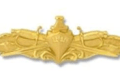
Why did the surface warfare officer (SWO) navy allow submarine officers authority to grant and receive surface warfare qualifications on surface ships? This practice was common during the 1970/80s. Under current navy instructions, submarine officers (1120 designator) are not eligible. Submarine officers knew seamanship, but that didn’t mean they understood or had any experience in shiphandling. Submarines do not steam in formation with each other, and do not perform tactical maneuvering operations with each other. They do not perform underway refueling, or aircraft operations on their deck. These submarine officers spent their careers on diesel boats that the navy was phasing out in favor of nuclear-powered submarines. They had nowhere else to go for command at sea assignments. What training and experience did these submarine officers receive before being assigned to command navy surface ships? I have an FOIA request pending to find out.
These submarine officers commanded non-combatant surface ships, such as tenders and other vessels (like the USS Point Loma AGDS-2). The idea of granting a surface warfare qualification to anyone on a non-combatant ship made no sense. But don’t ask too many questions. Some of these submarine officers granted surface warfare qualifications to women who were willing to have sexual affairs with them, and some women complied. The fact that they granted qualifications to those women made it easy for the senior submarine officers to avoid sexual harassment/ discrimination charges from other women who refused to engage in sexual affairs. “See, we granted qualifications! We awarded them Navy Commendation Medals! What’s the problem?” The problem on the USS Point Loma was that the submarine chain of command was afraid of scandal, and chose to ignore disciplining sexual misconduct, treating it like it didn’t happen. They were totally afraid of bad publicity, and the consequences of what that meant for the leadership’s reputation. The problem wasn’t just the sexual misconduct. It was tied to the integrity of the warfare qualifications that were issued from this ship. Qualification became more about politics than merit.
The submarine officer corruption was not limited to awarding qualifications to their sexual amours: they awarded SWO qualifications to each other, without testing knowledge. One submarine officer, who was chief of staff to the Commodore, was awarded SWO qualification even though he never served on a surface ship. This same officer told me to my face, “Women are not expected to qualify SWO. It’s just a decoration.” He kept his pin inside his desk, refusing to wear it on his uniform. Same man who evaluated my future in the Navy.
These submarine officers also had the authority to evaluate junior officers assigned to a surface ship for the first time. The USS McKee (AS-41) awarded Officer of the Deck (OOD) and SWO qualification to a woman lieutenant who was legally blind, meaning that she wore thick glasses that could not correct her vision to 20/20. Navy instructions on SWO eligibility state that 20/20 correctible vision is required without exception. This officer admitted that she was allowed to enter the navy with a waiver for her vision. But that waiver was intended for her to serve as a general unrestricted line officer ashore. Later, she volunteered for sea duty when it became available for women. So why did the navy ignore the waiver and assign her to a surface ship as a line officer?
On the USS Point Loma, a recently qualified woman lieutenant was assigned to be senior watch officer, a collateral duty. This woman stated openly that she saw other women SWO candidates as competition and a threat to her advancement in the surface ship community. Evaluating her peers gave her an unfair advantage, and it was a conflict of interest. All of which the Commanding Officer (CO) ignored because he accepted personal (although nonsexual) favors from her. She delayed and denied qualifications with her slander. Neither the CO or XO attended any boards, so they had no firsthand knowledge of how these oral boards were conducted. This lieutenant bitterly resigned from active duty as a lieutenant commander.
This is what I’ve been up against. The navy’s institutional reputation is more important than anyone’s individual career. Anyone who noticed and pointed out what was wrong became the problem, like me; a threat that must be discredited and eliminated. I wasn’t interested in accepting a fake qualification in exchange for moving on to some mediocre career that would end mid-grade, but that is what happened to all the others.
No one in the SWO navy monitored the integrity of THEIR qualification program. One has to wonder why?